Makiko Hattori
Makiko Hattori
Japanese, born in 1984
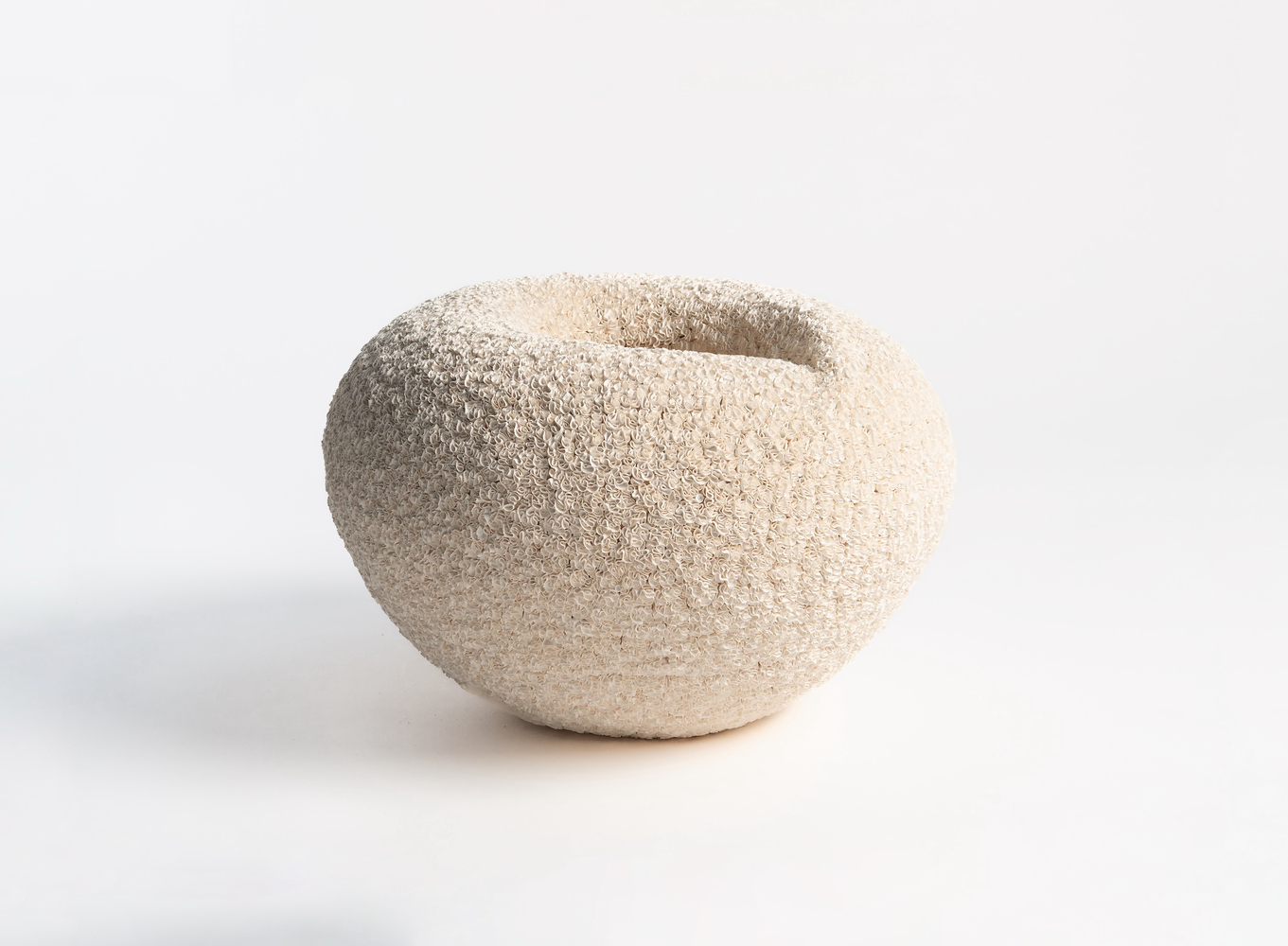
A distinctive voice in contemporary Japanese ceramics, Makiko Hattori has earned international attention for sculptures whose surfaces appear almost weightless, despite being formed from fired clay. Her works are defined by an enveloping surface built from countless tiny, ruffled elements, creating a quiet drama between softness and sharpness: what looks plush from a distance reveals a crisp, finely edged texture up close.
Born in Japan, Hattori trained at Aichi University of Education, completing her undergraduate studies in 2007 and finishing graduate study in 2009. Early recognition followed while she was still a student, including selections for major juried exhibitions and an international biennial, and she went on to receive significant awards such as the Choza Grand Prize at the Tokoname Ceramic Art Exhibition (2013) and the Mie Prefecture Cultural Award (2014). A formative early milestone came with a 2008 Tokyo exhibition. Notably, the surface vocabulary for which she is now widely known is often traced to a practical university assignment — an exercise in generating many different clay “expressions” — from which her densely layered textures emerged and quickly distinguished her work as something new.
Hattori’s method is famously demanding. She begins with a core sculptural form — often centred on a hollow or concave opening — and then painstakingly covers both exterior and interior with thousands of ribbon-like clay shavings, applied one by one, frequently using a thin needle to place each strand. Because the build-up is so dense, a single sculpture can require months of drying — sometimes up to six months — before firing. She typically leaves the work unglazed, and she is known for using Seto clay, choices that keep the surface’s minute shadows and edges fully visible rather than softened by glaze.
Over the last decade, Hattori’s career has expanded from prominent Japanese exhibitions to major international presentations, including a New York debut in 2017, followed by Coming to Life: Vernal Expressions in Clay (2023), a body of work often framed through themes of birth, growth, and natural emergence. Her sculptures are held in notable public collections, including the Victoria & Albert Museum (London), the Musée national des arts asiatiques – Guimet (Paris), the Minneapolis Institute of Art, and the Yingge Ceramics Museum (Taiwan), among others — an institutional footprint that underscores her place among the leading figures shaping contemporary ceramic sculpture today.
